a real conversation
free from projection
and ego-flexing
is a special gift
most do not talk to listen;
they talk to be heard
– yung pueblo
It has been six years since the last Gatineau Ottawa Agile Tour (GOAT) conference.
Six years is a long time in the world of technology, but it is an absolute lifetime when it comes to agile people, systems, and organizations. Last Saturday, over pizza and board games, I reflected with fellow agile coaches (and dear friends) on how our local practitioner community has evolved since 2019. One thing became abundantly clear: we have grown up.
The conversations we need to have today as an agile community are fundamentally different from the ones we were having a decade ago. When the GOAT organizing team sat down to envision what a return would look like for November 2026, we realized that simply dusting off the old playbook—inviting practitioners into a room to watch slides about the latest facilitation approaches and frameworks—was no longer going to serve this diverse community.
Here is what I see, and why GOAT 2.0 is intentionally breaking from its own tradition…
1. The Agile Community Has Grown Up
When Agile Ottawa began hosting meetups back in 2009, much of the content was focused on advocacy and baseline education. We were teaching the world how to step away from waterfall (remember when waterfall was the big baddy…?). Today, most foundational concepts are easily accessible via an AI prompt. Let’s be honest, our community doesn’t need another session explaining the mechanics of a daily stand-up.
Beyond this, many of us who were Product Owners or Scrum Masters have moved into leadership positions. As we became Managers, Directors, and Executives, we continued to lean on agile values and principles while grappling with something much deeper than the ongoing debates over agile frameworks:
- How does our agility help us navigate radical uncertainty?
- How do our values and principles inform us when making complex decisions and trade-offs?
- How do our practices and work systems (as they currently stand) nurture resilience?
As a community, we moved on from “how do we do agile?” to “how do we continue to deliver value in an increasingly complex, uncertain, and volatile world?”
2. We Are No Longer an Island
Many agilists have naturally integrated other disciplines into their work. Over the last six years, the lines between Agile, Lean, Product Management, Organizational Design, Change Management, and Project Delivery have beautifully (and sometimes messily) blurred. Even the Project Management Institute has integrated agile values, principles, and practices into its mandate.
Regardless of how you feel about that, we are a much bigger community now. The people driving product, delivery, and organizational decisions are blending agility into their existing practices. A conference that favors a single view of what it means to “be agile” dismisses the reality of how cross-functional leadership actually happens on the ground.
3. Radical Uncertainty Needs the Agile Community
The agile leaders in our Ottawa-Gatineau community are facing intense geopolitical shifts, macroeconomic and market pressures, and the dizzying acceleration of AI-driven change.
Nostalgic presentations won’t help us. Nostalgia, as we know, is not a strategy.
What we need right now is a mutually authentic and honest exchange about how agility, elevated, informs us as we navigate these choppy waters. We need a space where we can skip the theory, leave our egos at the door, and talk candidly about what is happening in our organizations.
That is why GOAT 2.0 is capped at 250 participants. It is intentionally designed as a peer exchange rather than a traditional broadcast conference. The morning will frame the complex disruptions we face—Geopolitics, the Future of Work, and AI—and the afternoon will be dedicated entirely to facilitated, candid breakout discussions among peers who are navigating the exact same operational realities you are.
It’s about relevance over scale. Depth over breadth. Participation over presentation.
If you are a decision-maker, an influencer, or someone leading delivery through this radical uncertainty, our community needs your voice in the room. I hope you will join us on November 26th to engage in the kind of real conversation that is, as yung pueblo notes, a special gift.
You can find the details and reserve your ticket at goagiletour.ca.
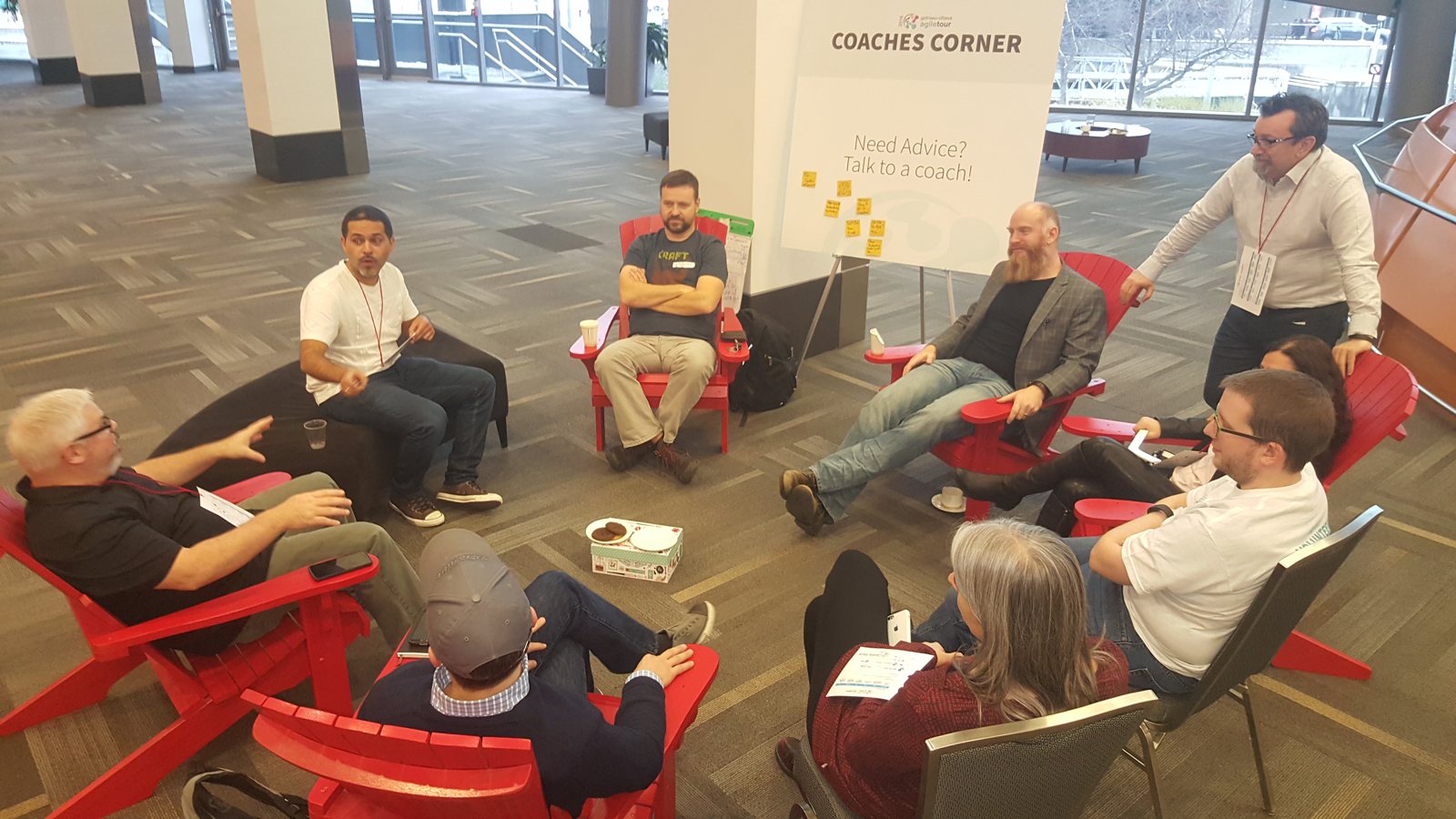
Image from “Coaches Corner” at GOAT 2016… hard to believe this was 10 years ago.

